
Work at Height Regulations 2005: What Building Owners and Managers Need to Know
- Jun 24
- 5 min read
If you own, manage or are responsible for a commercial building in the UK, the Work at Height Regulations 2005 are directly relevant to you — not just to the contractors you appoint. Understanding what the regulations require, and where responsibility sits, is essential for anyone involved in commissioning or managing work on roofs, facades and external structures.
This guide explains the key requirements in plain terms.

What Are the Work at Height Regulations 2005?
The Work at Height Regulations 2005 (WAHR) implement a European Directive and apply across Great Britain. They set out the legal framework for planning, supervising and carrying out any work where a person could fall a distance liable to cause personal injury.
The regulations apply regardless of the height involved. There is no minimum drop distance — if a fall could cause injury, the regulations apply.
They cover a wide range of activities relevant to building maintenance and management, including roof inspections, facade cleaning, window replacement, fall protection installation, guttering works and any other task that takes a person above ground level.
Who Has Duties Under the Regulations?
This is where many building owners and managers are surprised.
Duties under WAHR fall on:
Employers — who must ensure that work at height carried out by their employees is properly planned, supervised and executed.
Those who control work — including building owners, property managers, managing agents and principal contractors. If you are appointing contractors to carry out work at height on your building, you have a duty to ensure that the work is properly planned and that the contractors you appoint are competent.
The self-employed — who have duties in relation to their own work.
In practice, this means that commissioning a contractor to carry out roof or facade work does not transfer all responsibility away from you. You retain a duty to appoint competent contractors and to ensure the work is appropriately planned.

The Core Requirements
1. Avoid Work at Height Where Possible
The first duty under the regulations is to avoid work at height altogether if it is reasonably practicable to do so. In most building maintenance contexts this is not possible, but it is worth considering whether tasks can be redesigned or combined to reduce the number of times people need to access height.
2. Use Work Equipment or Measures to Prevent Falls
Where work at height cannot be avoided, the regulations require the use of appropriate work equipment or other measures to prevent falls. This includes collective protection measures — such as guardrails, edge protection or safety nets — which protect everyone in the area, not just the individual operative.
3. Minimise the Distance and Consequences of Falls
Where the risk of a fall cannot be entirely eliminated, measures must be in place to minimise the distance a person could fall and the consequences if they do. This includes the use of fall arrest systems, personal protective equipment and properly designed anchor points.
4. Plan and Supervise All Work at Height
All work at height must be properly planned before it begins. This includes assessing the risks, selecting appropriate access methods, identifying emergency and rescue procedures, and ensuring that the right equipment and competent personnel are in place.
The regulations are explicit that rescue planning is not optional. A rescue procedure must be established before work starts — not after an incident has occurred.
5. Ensure Competence
Everyone involved in planning, supervising and carrying out work at height must be competent to do so. Competence means having the appropriate skills, knowledge and experience for the task — not simply holding a generic health and safety card.
For rope access work specifically, IRATA certification is the recognised standard for demonstrating competence. For work involving mobile elevated work platforms (MEWPs), IPAF training is the equivalent benchmark.
Fragile Surfaces
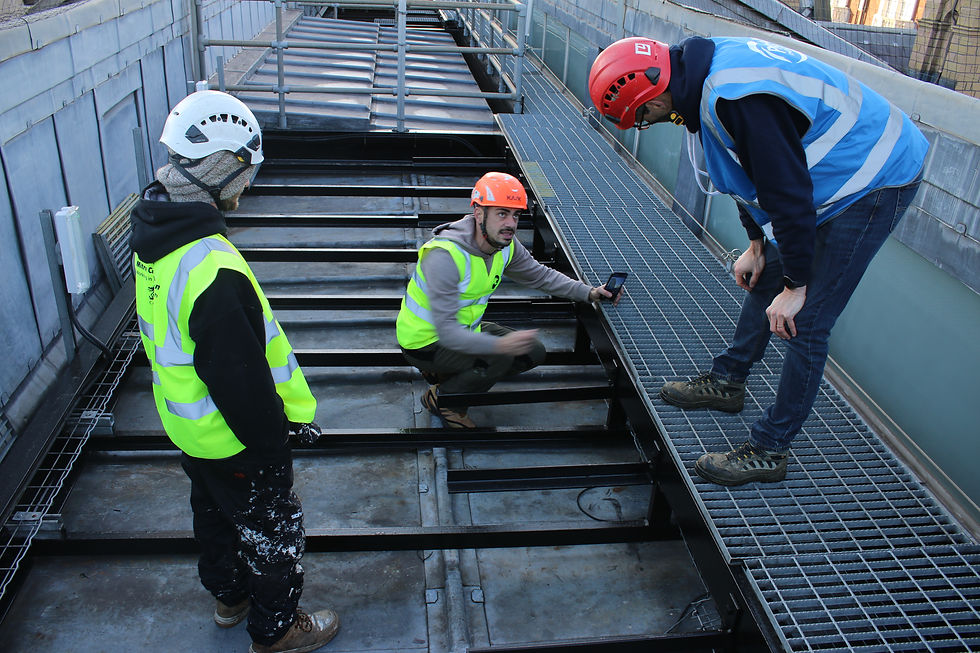
The regulations include specific requirements for work on or near fragile surfaces including many types of roof covering, rooflights, and older industrial roofing materials. Where fragile surfaces are present, additional measures must be in place to prevent people falling through them, including physical barriers, coverings or warning signs.
Building managers should ensure that any contractor working on roofs is made aware of fragile surface risks before work commences.
Inspection of Fall Protection Equipment
The regulations require that any equipment used to prevent or arrest falls is inspected at appropriate intervals by a competent person. For permanent fall protection systems — such as eyebolts, horizontal lifelines and anchor points — this typically means a statutory inspection every 6 or 12 months depending on the system and the level of use.
Inspection records must be kept and made available. A fall protection system with no inspection history provides no assurance of compliance and no protection in the event of an incident or insurance claim.
What This Means in Practice for Building Managers
If you are responsible for a commercial building, the following actions are directly relevant to your duties under WAHR:
Know what fall protection systems exist on your building — if you do not have a record of what has been installed and when it was last inspected, commission a survey.
Ensure annual or biannual inspection of fixed fall protection — this is a legal requirement, not a recommendation.
Appoint competent contractors — ask for evidence of relevant qualifications (IRATA for rope access, IPAF for MEWPs) and check that method statements and risk assessments are in place before work starts.
Request rescue plans — any contractor working at height on your building should be able to provide a site-specific rescue procedure before commencing work.
Keep records — inspection certificates, method statements and risk assessments should be retained as part of your building's health and safety file.
How ProAltus Can Help
ProAltus works with building owners, property managers, FM teams and principal contractors to plan and deliver compliant work at height across a wide range of building types and maintenance activities.
Our services include fall protection surveys and inspection reports, access strategy design, permanent fall protection installation and certification, and the delivery of rope access works by IRATA-trained operatives with full method statements and rescue planning as standard.
If you are unsure whether your building's fall protection systems are compliant, or need support planning access for an upcoming maintenance programme, we are happy to advise.
Call us: 01638 781 541 Email: sales@proaltus.co.uk


